Two Different Ways to Measure Trust
What is Edelman Trust Management?
Edelman Trust Management vs RepTrak comes down to where the score comes from. Edelman Trust Management runs an AI system, Trust Stream, that scores earned media, social content, and employee reviews into a single audience-agnostic metric called the Edelman Net Trust Score, and pairs it with bespoke ETM Corporate Studies for one-off, company-specific research. RepTrak measures a single company's reputation through a standardized survey model: an overall Reputation Score and seven weighted Drivers, applied the same way to every company, benchmarked against named competitors, and tracked continuously through Compass. If your team needs a trust read built from real-time media and social signals, Trust Stream is built for that. If your team needs standardized, benchmarked reputation data comparable across companies and stakeholder groups, that's RepTrak's model.
What is Edelman Trust Management?
Edelman Trust Management is Edelman's ongoing trust measurement and advisory practice, distinct from the annual Trust Barometer. Its core metric is the Edelman Net Trust Score (ENTS), a single, audience-agnostic score built from a two-year academic validation program and scored across four dimensions: Ability, Integrity, Dependability, and Purpose. Two products carry it. Trust Stream is an always-on system that applies Edelman's ArchieAI model to earned media, social content, employee reviews, and survey data, drawing on a Trust Data Lake built from more than 20 years of Trust Barometer research. ETM Corporate Studies are bespoke, company-specific research engagements sold separately from Trust Stream.
Edelman publishes validation figures tying its ENTS trust framework to stock performance, media coverage, and employee loyalty, including a 5 percent sector outperformance figure drawn from 31 U.S. companies in 2018.
What does RepTrak measure?
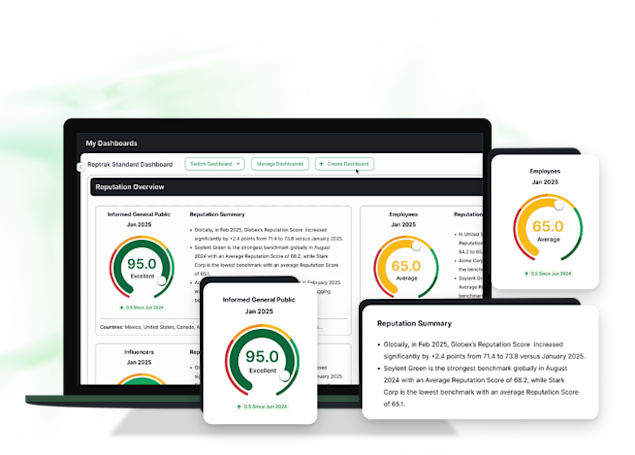
RepTrak measures a single company's reputation, scored continuously and benchmarked against named competitors. It combines an overall Reputation Score and seven weighted Drivers (Products & Services, Performance, Innovation, Leadership, Conduct, Citizenship, and Workplace) as integrated components of one multi-stakeholder framework, linked to business outcomes. Clients select the stakeholder groups most relevant to their business, including direct and targeted stakeholders such as Employees, Customers, Policymakers, and Influencers; the number included varies by package, drawn from RepTrak's set of 20+ stakeholder types. The score is tracked through the Compass platform.
The two models start from different raw material
The two models start from different raw materials. Trust Stream reads unstructured signals (media coverage, social posts, employee reviews) and scores it with a large language model trained on Edelman's historical research. RepTrak asks stakeholders directly, through a standardized survey instrument applied consistently across companies, industries, and markets.
That difference shows up in what each score can support. A signal-based score updates as fast as the underlying content does and can flag a shift the same day it appears. A survey-based score moves more slowly, but every point on it traces back to what a named stakeholder group actually said when asked a consistent question. That traceability is what makes company-to-company and driver-to-driver comparison possible at all.
RepTrak vs Edelman Trust Management: Side by Side
| RepTrak | Edelman Trust Management | |
|---|---|---|
Core metric | Reputation Score (0–100), combined with seven weighted Drivers as integrated components of one model | Edelman Net Trust Score (ENTS): a single, audience-agnostic trust score |
Model structure | Think-Feel-Do framework: Drivers measure what stakeholders think, the Reputation Score captures how they feel, seven Business Outcomes measure what they do | Four dimensions (Ability, Integrity, Dependability, Purpose) combined into one ENTS |
Data Source | Structured survey research, one consistent instrument across companies and stakeholder groups | |
Competitive benchmarking | Client-selected competitive set compared on the same survey scale over time, so every competitor's score comes from the same instrument and stakeholder groups | Benchmark trust against top competitors and within an industry; whether the set is client-defined and held fixed is not specified publicly |
Business outcome linkage | Seven named Business Outcomes (Buy, Recommend, Say Something Positive, Trust to Do the Right Thing, Work For, Invest, Benefit of the Doubt), linked to the score | Aggregate published findings: stronger stock performance, higher positive media coverage, stronger employee advocacy versus low-trust peers |
Cadence | Continuous, through Compass | Trust Stream: always-on, real-time; ETM Corporate Studies: scoped per engagement |
Study history | Traces to the Reputation Institute (1999); rebranded as RepTrak in 2020; over 20 years of comparable data | ENTS framework from a two-year academic validation program; Trust Stream's Data Lake draws on 20+ years of Trust Barometer research |
Flagship annual study | Not applicable — RepTrak's model is continuous, not anchored to one release | |
Geographic and company footprint | 60+ countries, 6,000+ companies, 30+ industries | 800+ global organizations measured |
Ideal buyer | Teams wanting a standardized, benchmarked score comparable across companies and stakeholder groups | Teams wanting real-time signal monitoring plus one summary number, or a bespoke one-time trust study |
Named-competitor benchmarking is the widest gap
Named-competitor benchmarking is the widest gap, and it's the row worth double-checking before choosing either product. RepTrak benchmarks every company's score against named competitors by default: a client picks its competitive set, and RepTrak reports every company in it on the same scale, wave after wave. Edelman's public materials describe Trust Stream as benchmarking trust performance and identifying what builds or undermines it "for brands and competitors," but don't specify whether a standing, named competitive set is part of every engagement or scoped project by project. For a team that needs a fixed competitive set tracked consistently without renegotiating scope each time, that distinction is worth confirming directly with an Edelman account team.
Edelman Trust Management's clearest strength
Edelman Trust Management's clearest strength is speed. Trust Stream is built to catch a reputational shift the same day it shows up in coverage or social conversation, which a wave-based survey model isn't designed to do. ArchieAI's foundation, a Trust Data Lake spanning more than 20 years of Trust Barometer research, gives it real depth to score against. The four-dimension ENTS framework is also a genuinely simple number to report: a board that wants one trust indicator gets one, without a multi-driver model to explain first. Edelman backs the score with published business-outcome research, not just the score in isolation.
Should you choose Edelman Trust Management or RepTrak?
Choose Edelman Trust Management if your team needs to catch a trust shift as it's happening in media and social conversation, or wants a single, audience-agnostic number to report to a board without walking through a multi-driver model first.
Choose RepTrak if your team needs a standardized score that's comparable across your own company, named competitors, and multiple stakeholder groups on the same scale, wave over wave.
A team building real-time listening on top of an existing reputation program is better served starting with Trust Stream. A team that doesn't yet have a benchmarked, standardized reputation model, one that holds up the same way across every stakeholder group and every named competitor, is better served starting with RepTrak. The two aren't mutually exclusive: a communications function can run Trust Stream for daily signal and RepTrak for the benchmarked score it reports to the board each quarter.
If you want to know how your company's Reputation Score compares against named competitors, talk to us.
FAQ's
Edelman Trust Management scores media, social, and employee-review signal through an AI model into a single trust number. RepTrak surveys stakeholders directly through a standardized model, producing an overall Reputation Score and seven weighted Drivers benchmarked against named competitors.
Yes. Both Trust Stream and ETM Corporate Studies are built for a single organization, unlike the Edelman Trust Barometer, which measures trust in institutional categories rather than individual companies.
No. The Trust Barometer is Edelman's annual, 28-country survey of institutional trust. Trust Management is a separate practice built around the Edelman Net Trust Score, delivered through Trust Stream and ETM Corporate Studies.
Edelman describes Trust Stream as benchmarking trust performance for brands and competitors, but doesn't state whether a standing, named competitive set is included by default. Confirm scope directly with Edelman before assuming it matches RepTrak's approach.
Both are continuous, but on different data. RepTrak's Compass platform tracks a standardized survey score continuously. Trust Stream tracks real-time signal from media, social content, and employee reviews continuously. Neither is an annual snapshot.
It depends on what the board wants to see. ENTS gives a single, audience-agnostic number. RepTrak's Reputation Score comes with seven named Drivers, so a shift in the number traces back to something specific — Conduct, Workplace, Innovation — that the board can ask about directly.
Yes. They answer different questions from different data: Trust Stream and ETM Corporate Studies read signal in near real time, RepTrak delivers a standardized, benchmarked score comparable across companies and stakeholder groups.
RepTrak's Reputation Score is an overall score, integrated with seven weighted Drivers, linked to business outcomes such as buying, recommending, and extending the benefit of the doubt during a crisis.