Ways to Measure Stakeholder Trust
RepTrak vs Ipsos: Which Is Better for Measuring Stakeholder Trust?
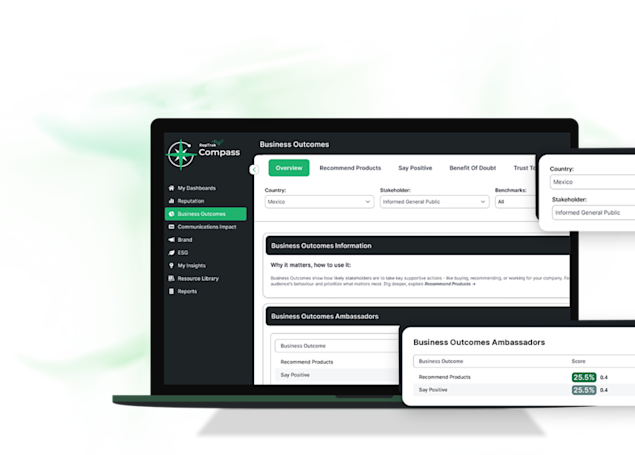
Ipsos vs RepTrak comes down to whether trust is the whole picture or only one signal in a larger scoring model. Ipsos treats trust as reputation's central driver, measuring it across stakeholder groups through its RISE research system. RepTrak treats trust as one specific, Business Outcome, "Trust to Do the Right Thing," inside a broader model: an overall Reputation Score and seven weighted Drivers, benchmarked against competitors and tracked continuously through Compass. If your team needs a deep, standalone read on how much stakeholders trust the company, Ipsos is built for that. If your team needs trust set inside a fuller reputation model with Drivers, competitive benchmarking, and linked business outcomes, that's RepTrak's model.
Key takeaways
Trust measurement: Ipsos measures trust directly through its RISE research, organized by stakeholder groups. RepTrak measures trust as one Business Outcome, "Trust to Do the Right Thing," within a seven-Driver reputation model.
Tracking cadence: RepTrak provides continuous, always-on tracking of its Reputation Score via the RepTrak Compass platform. By contrast, Ipsos delivers periodic, point-in-time reads (typically quarterly or annually).
Competitor benchmarking: RepTrak benchmarks against selected competitors, industries, and markets on the same normative scale. Ipsos benchmarks against sector and regional norms.
Investor trust: RepTrak measures investor behavior as Invest, a Business Outcome benchmarked across a client's competitive set. Ipsos ties investor trust to "confidence to invest ... willingness to ride out downturns."
Stakeholder coverage: RepTrak publishes a defined set of 20+ client-configurable stakeholder types. Ipsos describes several groups in detail but does not publish a fixed list
What is Ipsos?
Ipsos is a global market research and polling company, and corporate reputation research is one of its major solution areas. Its Global Reputation Center advises businesses on reputation performance, key value drivers, stakeholder trust and expectations, and crisis severity and recovery. The core offering treats trust as reputation's central driver, and its RISE system (Reputation Intelligence for Strategic Evaluation) combines survey data with non-survey signals, including AI-curated social listening and traditional media coverage, filtered by stakeholder audience. Ipsos also runs a Reputation Council of more than 150 global senior communicators, and a 2017 Global Reputation Monitor study surveyed more than 100 of the world's largest companies, ranking them into trust tiers.
What does RepTrak measure?
RepTrak measures a single company's reputation, scored continuously and benchmarked against competitors. Benchmarks also run against specific industries and markets, plus aspirational benchmarks outside your industry, all on the same normative scale over time. It combines an overall Reputation Score and seven weighted Drivers (Products & Services, Performance, Innovation, Leadership, Conduct, Citizenship, and Workplace) as integrated components of one multi-stakeholder framework, linked to business outcomes. Clients select the stakeholder groups most relevant to their business, including direct and targeted stakeholders such as Employees, Customers, Policymakers, and Influencers; the number included varies by package, drawn from RepTrak's set of 20+ stakeholder types. The score is tracked through the Compass platform.
How each platform actually measures trust
Ipsos treats trust as the core subject of its research. RepTrak treats trust as one standardized metric within a broader reputation model. Ipsos goes deeper on what builds trust with each stakeholder group, while RepTrak makes trust comparable across companies and industries on the same scale.
Ipsos measures trust through RISE, which blends structured survey data with social listening and media signals, then organizes findings by stakeholder audience. Ipsos also runs employee workshops to close the gap between what a company promises and what stakeholders feel it delivers.
RepTrak asks stakeholders a standardized set of questions using one consistent instrument. Trust rolls into a named Business Outcome, "Trust to Do the Right Thing," which sits alongside six other Business Outcomes and seven reputation Drivers.
RepTrak vs Ipsos: Side by Side
| RepTrak | Ipsos | |||
|---|---|---|---|---|
Core metric | Reputation Score (0–100), combined with seven weighted Drivers as integrated components of one model | No single published index; trust measured through RISE across multiple stakeholder groups | ||
Trust as a metric | "Trust to Do the Right Thing," one of seven Business Outcomes | The central, standalone metric the model is built around | ||
Model structure | Think-Feel-Do framework: Drivers measure what stakeholders think, the Reputation Score captures how they feel, seven Business Outcomes measure what they do | Trust-centered model combining survey data with non-survey social and media signal (RISE), filtered by stakeholder audience | ||
Stakeholder coverage | 20+ stakeholder types, client-selected per package, drawn from a defined set. AI platforms can also be measured as a stakeholder through AI as a Stakeholder™, on the same model and 0 to 100 scale as human audiences. | Several groups detailed publicly (Regulators, NGOs, Consumers, Investors), with employees, media, suppliers, and local communities referenced more broadly; no fixed or exhaustive list published | ||
Data source | Structured survey research, one consistent instrument across companies and stakeholder groups | Survey research plus non-survey social listening and media data, plus qualitative employee workshops | ||
Competitive benchmarking | Selected competitors, industries, and markets, on the same normative scale | Normative data by sector and region; not confirmed as a standing, competitor panel | ||
Business outcome linkage | Seven Business Outcomes (Buy, Recommend, Say Something Positive, Trust to Do the Right Thing, Work For, Invest, Benefit of the Doubt), linked to the score | Trust linked to outcomes per stakeholder group (investor confidence, employee retention, media credibility), not delivered as one integrated scoring model | ||
Cadence | Continuous monthly reporting cycle | Periodic, point-in-time reads (typically quarterly or annually), with no published fixed survey frequency or panel size for corporate reputation | ||
Advisory support | An advisory team is included in the subscription to help clients diagnose results, prioritize drivers, and act on them | Consultant-led project work. Clients commission studies and depend on Ipsos to run and interpret them. | ||
Geographic and company footprint | 60+ countries, 6,000+ companies, 30+ industries | Global reach across "some of the world's biggest companies"; company-level footprint figures aren't published for the current offering | ||
Ideal buyer | Teams wanting a standardized, benchmarked score comparable across companies and stakeholder groups | Teams wanting deep trust research across named stakeholder categories, especially where qualitative insight matters alongside survey data |
How does stakeholder coverage differ between Ipsos and RepTrak?
RepTrak publishes a defined, numbered stakeholder framework. Ipsos does not. Both platforms survey multiple stakeholder groups, so the difference isn't flexibility but how clearly each documents its coverage.
RepTrak lets clients choose from 20+ stakeholder types, including Employees, Customers, Policymakers, and Influencers, with the number included varying by package.
Ipsos's public materials describe several stakeholder groups in detail, each tied to a distinct outcome. Investors, for example, are tied to "confidence to invest ... willingness to ride out downturns." Ipsos also references employees, media, suppliers, and local communities more broadly, without publishing a fixed list.
How do reporting and benchmarking differ between Ipsos and RepTrak?
RepTrak benchmarks against selected competitors, industries, and markets on the same normative scale. For a team that needs to show the board how it compares to specific rivals over time, RepTrak supports that directly.
RepTrak scores every company against a selected set of competitors on the same survey scale, so results stay directly comparable from one reporting period to the next.
Ipsos uses normative data by sector and region, which gives useful context but doesn't necessarily track the same competitors wave after wave. Teams that need competitor tracking from Ipsos should confirm it as part of the engagement rather than assume it from public materials.
Which platform is better for investor relations?
RepTrak is the better fit for investor relations teams that need a repeatable, board-ready metric. It measures investor trust as Invest, one of seven Business Outcomes, linked to the Reputation Score and benchmarked against competitors on the same scale. The data is updated monthly, so IR teams can report to the board every quarter on the latest reading. Ipsos also measures investor trust, framing it as "confidence to invest ... willingness to ride out downturns," but based on what's publicly documented, its research reads more like a study than a recurring metric.
Which platform is better for communications leaders?
It depends on what the comms leader needs. RepTrak is better for leaders who report upward on data: its continuous, benchmarked Reputation Score breaks into seven Drivers, so any shift traces back to something specific they can act on. Ipsos is better for leaders who want peer perspective: its Reputation Council gives direct access to 150+ senior communicators for comparing notes on reputation strategy.
What Ipsos does well
Ipsos's clearest strength is research depth. Its Global Reputation Monitor study (2017) covered more than 100 of the world's largest companies, and RISE's hybrid approach, combining structured surveys with AI-curated social listening and media data, gives it a richer qualitative picture than a pure survey instrument alone. The Reputation Council gives access to a peer network of senior communicators, a qualitative perspective that complements the research. For a team that wants deep, one-time or periodic research into what's building or eroding trust with a specific stakeholder group, Ipsos's approach is built for that kind of project.
Should you choose Ipsos or RepTrak?
Start with RepTrak if you need a continuous, benchmarked score to report to the board every quarter. Start with Ipsos if you need a periodic or one-time deep dive into what drives trust with a specific stakeholder group. Many teams will benefit from both.
Choose Ipsos if your team needs deep trust research across named stakeholder groups, wants qualitative insight from social listening and employee workshops, or values access to a peer network of senior communicators.
Choose RepTrak if your team needs a standardized score that's comparable across your own company, competitors, and multiple stakeholder groups, tracked continuously on the same scale, with advisory support to act on the results.
If you want to know how your company's Reputation Score compares against competitors, talk to us.
FAQ's
Ipsos measures trust directly as reputation's central driver, across several stakeholder groups, through its RISE research system. RepTrak measures trust as one Business Outcome within a broader model: an overall Reputation Score and seven weighted Drivers, benchmarked against competitors.
No. Based on Ipsos's public materials, Ipsos does not publish a single benchmarked reputation score comparable to RepTrak's Reputation Score. Ipsos measures trust through its RISE research across multiple stakeholder groups, reporting results by group rather than rolling them into one number.
RepTrak surveys 20+ defined stakeholder types, with clients selecting the groups most relevant to their business. Ipsos does not publish a fixed number. Its public materials detail Regulators, NGOs, Consumers, and Investors, and reference employees, media, suppliers, and local communities more broadly.
Ipsos's public materials describe benchmarking against normative data by sector and region, but they don't confirm a standing panel of named competitors like the one RepTrak uses. Teams that need named-competitor benchmarking should verify this directly with an Ipsos account team.
RepTrak. It measures investor behavior as Invest, a Business Outcome benchmarked against competitors on the same scale every reporting period. Ipsos treats investor trust as a stakeholder category tied to confidence and downturn resilience, but its public materials don't document a recurring, benchmarked reporting cadence for it.
A peer network of more than 150 global senior communicators that Ipsos runs alongside its research offerings. It's a qualitative forum, not a quantitative benchmarking panel.
Yes. Ipsos's research can identify what's driving or eroding trust with a specific stakeholder group in depth. RepTrak can then track, continuously and on a benchmarked scale, whether acting on those findings actually moves the reputation score.