What's Being Said vs What Stakeholders Believe
RepTrak vs Meltwater: What's Being Said vs What Stakeholders Believe
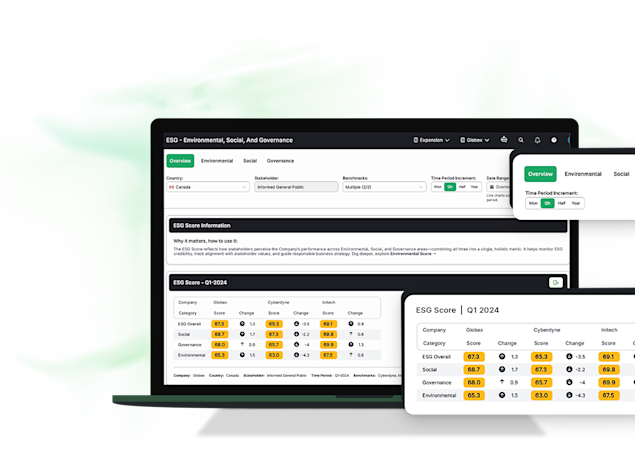
RepTrak vs Meltwater comes down to what is said versus what is believed. Meltwater sells brand monitoring and reputation management, and it scores sentiment, share of voice, and reputational risk from published content. RepTrak asks stakeholders directly what they believe about a company and what they would do because of it. It measures a Reputation Score and seven weighted Drivers that explain what shapes it, benchmarks results against named competitors, and links them to business outcomes. If your team needs to see what is being said and catch risk early, Meltwater is built for that. If it needs to know what stakeholders believe and what is moving that belief, that's RepTrak.
Key takeaways
Metrics: Meltwater scores sentiment, share of voice, and risk from published content; RepTrak scores belief through a Reputation Score, seven Drivers, and Business Outcomes.
Use cases: Meltwater fits risk, alert, and coverage questions; RepTrak fits belief questions and leadership reporting.
AI answers: GenAI Lens, typically a Meltwater add-on, tracks how brands appear in AI answers; RepTrak’s AI as a Stakeholder™ measures how AI platforms perceive a company using the same framework it uses for human stakeholders. It shows the reasoning and sources behind each score, so you can see what’s driving it.
Choosing: Start with Meltwater for what is said and RepTrak for what is believed; many teams use both.
What is Meltwater?
Meltwater is a media, social, and AI intelligence platform. Its platform page says 27,000+ customers use it across 130+ countries. Its products include media monitoring, social listening, brand monitoring and reputation management, consumer intelligence, and PR reporting.
Meltwater's brand monitoring and reputation management page describes a five-step workflow. Teams detect emerging risk, understand why perception is shifting, and quantify exposure against competitors. They then act through alerts sent to Slack or Microsoft Teams and report to leadership. The page also describes a customizable risk score but doesn't specify its inputs. Its consumer intelligence page covers trend detection and what audiences care about.
Meltwater's Media Monitoring page lists 200M+ online publications, 400,000+ print publications, 20,000+ podcasts, and broadcast across all 210 US media markets. It says it pulls in mentions "as they happen." Meltwater's AI assistant, Mira, generates executive-ready summaries and answers questions about that data.
GenAI Lens extends monitoring to AI platforms, including ChatGPT, Perplexity, Google AI Overviews, Gemini, and Claude. Meltwater typically sells it as an add-on. Meltwater's PR Reporting product reports reach and impressions, share of voice against competitors, sentiment and emotion analysis, and custom KPIs.
What does RepTrak measure?
RepTrak measures corporate reputation. Its tracking footprint covers 6,000+ companies measured to date, 60+ countries, and 30+ industries. Across all its work, RepTrak collects an estimated 5M+ individual ratings per year.
For a typical client that measures the Informed General Public (IGP), RepTrak captures an average of more than 2,000 individual ratings per company in each country each year. The total depends on the stakeholder groups a client chooses, how often data is collected, and the sample size needed to be representative. The Reputation Score measures how stakeholders feel about a company. Seven weighted Drivers show what shapes that feeling. The Drivers are Products & Services, Performance, Innovation, Leadership, Conduct, Citizenship, and Workplace.
RepTrak's model follows Think-Feel-Do. The Drivers capture what stakeholders think, and the Reputation Score captures how they feel. The seven Business Outcomes capture what they would do. They are Buy, Recommend, Say Something Positive, Trust to Do the Right Thing, Work For, Invest, and Benefit of the Doubt.
Clients select the stakeholder groups most relevant to their business, such as Employees, Customers, Policymakers, and Influencers. RepTrak draws on 20+ stakeholder types, and the number included varies by package. The score is tracked continuously through the RepTrak Compass platform.
Meltwater collects what's published; RepTrak asks stakeholders directly
Meltwater collects what has been published or posted. RepTrak asks stakeholders what they believe. Coverage shows what was said and how far it spread. Only a survey shows what stakeholders concluded from it.
RepTrak's own data shows the gap. In RepTrak's analysis of an airline incident, the airline handled the response while its aircraft manufacturer faced questions about quality, safety, and oversight. Read on its own, the coverage might suggest one company suffered more reputational harm than the other. RepTrak's data showed both Reputation Scores dropped roughly 11% in the month after the event. The August 2026 post concludes that "where accountability sits in a story and where reputation damage lands are two different findings."
That post addresses media metrics in general, not Meltwater. The logic applies to any tool that reads published content: it shows who was in the story, and only survey data shows where belief moved.
Meltwater's consumer intelligence page argues that surveys rest on small samples of people who opt in. That is a fair concern for any thin panel. RepTrak asks stakeholders the same standardized questions, so scores compare across companies and stakeholder groups. Monitoring hears only the stakeholders who post publicly.
RepTrak collects an estimated 5M+ individual ratings a year across its programs. Respondents must be familiar with a company before they rate it, and every response is checked for speeders and failed attention checks. The panel partner is Dynata, and respondents sourced elsewhere in some markets get the same quality checks. Results track continuously through Compass.
Meltwater scores what's said; RepTrak scores what's believed
Meltwater scores sentiment, share of voice, and reputational risk, which makes it a genuine reputation-management tool. Those scores describe how a brand is discussed and how exposed it is. RepTrak's Reputation Score describes how stakeholders feel, and its seven Drivers show what is behind the score. A movement in the score traces to something specific, such as Conduct, Workplace, or Innovation.
Visibility and belief can also diverge. RepTrak's August 2026 post on campaign KPIs shows the pattern in campaign data. Across 10 major economies in 2025, sport sponsorships earned recall of 32%, well above benchmark, but a reputation impact of +8.9, below benchmark. The campaign average is +11.2. That post measures campaign recall, not media coverage, and it treats reputation impact as a layer added to activity metrics, not a replacement for them.
Meltwater's PR Reporting page lists "indicators of brand impact and business relevance" alongside its coverage metrics. Meltwater says its reporting links coverage to business outcomes a client already tracks. RepTrak's Business Outcomes come from stakeholders' own answers, so they show what people say they would do.
Side by side: RepTrak vs Meltwater
Side by side: RepTrak vs Meltwater
Meltwater fits risk and coverage questions; RepTrak fits belief questions
Meltwater fits questions about risk and coverage. Its brand monitoring page routes alerts to Slack and Microsoft Teams so communications, risk, and legal teams can respond while a narrative is still forming. It also helps teams tell whether a shift in perception is industry-wide or specific to the brand.
RepTrak fits questions about what stakeholders believe. The August 2026 airline post lists what leadership asks. Did stakeholder perceptions improve or deteriorate? Are stakeholders more or less willing to buy, recommend, invest, or work there? Coverage metrics don't answer those directly.
Each Business Outcome maps to a stakeholder question. Buy and Recommend speak to customer behavior, Work For to talent retention, and Invest to investor relations. Benefit of the Doubt shows how a company is judged when something goes wrong.
What does Meltwater do well?
Meltwater's clearest strength is a real-time view of coverage and reputational risk. It spans online, print, podcast, broadcast, and social sources in one platform. It says it pulls in mentions "as they happen." Its detection flags unusual shifts in sentiment, volume, narrative themes, and engagement, not only keyword matches. A negative story can trigger an alert while it is still spreading. A survey measures belief after it forms.
GenAI Lens is its second strength. It tracks how a brand appears across AI platforms and which sources and citations shape those answers. Add Mira summaries and the five-step workflow, and a comms team can run daily work in one place.
Should you choose Meltwater or RepTrak?
Start with Meltwater if you need to know what is being said about your company and where risk is emerging. Start with RepTrak if you need to know what stakeholders believe and what is moving that belief. Many teams will benefit from both. Meltwater gives comms and risk teams a continuous view of coverage. RepTrak gives communications and corporate affairs a benchmarked reputation score, with Drivers that show where to act.
Choose Meltwater if your team needs a real-time view of coverage and reputational risk, alerts when sentiment shifts, or visibility into AI answers.
Choose RepTrak if your team needs stakeholder views beyond published content, wants a continuously tracked benchmark, or needs to see which Drivers move the score.
If you're comparing reputation platforms, use RepTrak's five questions to ask any reputation intelligence vendor before you sign.
If you want to know how your company's Reputation Score compares against named competitors, talk to us.
FAQ's
Meltwater scores sentiment, share of voice, and reputational risk from published content. RepTrak asks stakeholders directly and measures reputation through a Reputation Score and seven weighted Drivers, benchmarked against named competitors.
Meltwater measures reputation signals. Its brand monitoring page presents the product as reputation management and scores sentiment, share of voice, and risk from published content. That approach infers reputation from what is said. RepTrak measures it by asking stakeholders, and its Reputation Score is a 0-100 measure of how they feel about a company.
Not necessarily. In RepTrak's airline analysis, coverage told a different story about accountability than the Reputation Scores did, and both companies dropped roughly 11%. Coverage shows what ran. Stakeholder belief shows what landed.
Meltwater's public pages describe no stakeholder survey. They describe monitoring of published content: online news, print, podcasts, broadcast, social posts, and AI platform answers. RepTrak draws on an estimated 5M+ individual ratings a year across 20+ stakeholder types, and clients select the groups most relevant to their business. The number of types included varies by package.
Yes, through GenAI Lens, which Meltwater typically sells as an add-on. It tracks platforms including ChatGPT, Perplexity, Google AI Overviews, Gemini, and Claude, and reports prevalence scores, AI share of voice, and citations. RepTrak's AI as a Stakeholder™ measures how AI platforms perceive a company using the same framework it uses for human stakeholders. It shows the reasoning and sources behind each score, so you can see what's driving it.
Meltwater monitors continuously and says it pulls in mentions "as they happen." GenAI Lens refreshes its AI-answer data on a set cycle. RepTrak's Reputation Score is tracked continuously through Compass, with a monthly reporting cycle that can vary by stakeholder group.
Yes. Meltwater compares sentiment, share of voice, and narrative against competitors, and it shows whether an issue is industry-wide or specific to the brand. RepTrak benchmarks a client-selected competitive set on the same survey scale over time.
RepTrak is the stronger fit for board reporting on reputation, because it benchmarks what stakeholders believe against named competitors. Meltwater supplies the coverage and risk context behind a specific story, such as how it spread and which sources carried it.
Yes. One workable split: Meltwater runs daily monitoring and early-warning alerts, and RepTrak supplies the benchmarked score and Drivers for leadership reviews.