Which Reputation Platform Fits?
RepTrak vs Group Caliber
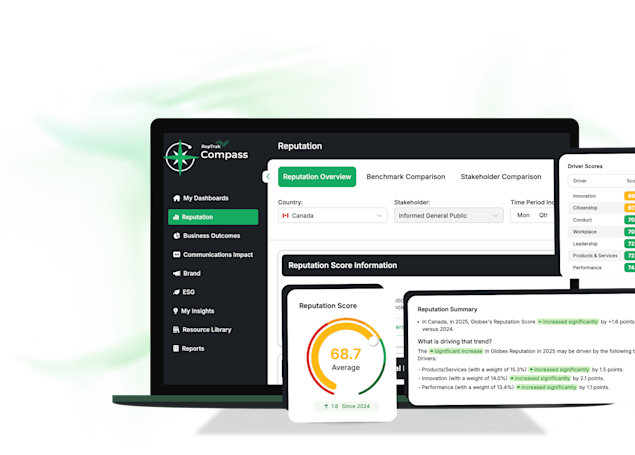
RepTrak measures reputation through an overall Reputation Score and seven reputation Drivers that explain what shapes it, with over two decades of comparable data behind it. Caliber is a Copenhagen-founded platform anchored on a single two-question daily metric, launched in 2016. Choose Caliber for a fast, lightweight daily pulse. Choose RepTrak for a deeper, dimension-by-dimension model with a longer track record.
What is Group Caliber?
“Stakeholder intelligence that turns feedback into strategy. Track trust, brand, and reputation in real time and move from insight to action.”
Which Reputation Platform Fits?
RepTrak measures reputation through an overall Reputation Score and seven reputation Drivers that explain what shapes it, with over two decades of comparable data behind it. Caliber is a Copenhagen-founded platform anchored on a single two-question daily metric, launched in 2016. Choose Caliber for a fast, lightweight daily pulse. Choose RepTrak for a deeper, dimension-by-dimension model with a longer track record.
Built on more history. RepTrak’s model has over two decades of validated reputation data behind it. Caliber launched in 2016, founded by former Reputation Institute researchers who prioritized speed and flexibility over standardization. Their custom-configured engagements appeal to buyers who want tailored measurement, but customized methodologies can’t produce comparable benchmarks across clients.
Different starting points, same “always-on” pitch. Caliber’s core metric updates daily off two questions. RepTrak measures overall reputation alongside seven key areas that explain what drives it and link to business outcomes.
Different published footprints. RepTrak’s flagship report covers 14 major markets, with a broader tracking beyond them. Caliber publishes rankings in 11 markets, with tracking that extends further.
Both platforms argue that reputation should be measured continuously, not commissioned as a one-off study. That’s where the similarity mostly ends.
RepTrak vs Caliber: Side by Side
| RepTrak | Group Caliber | |
|---|---|---|
Core metric | ||
Model structure | Think-Feel-Do framework linking what stakeholders think, feel, and do: seven Reputation Drivers measure what they think; the Reputation Score captures how they feel; and seven Business Outcomes measure intended supportive behaviors. | |
Business outcome measures | ||
Founded | Traces to Reputation Institute (1999); rebranded The RepTrak Company in 2020; over 20 years of reputation data | 2016, by two former Reputation Institute directors |
Data cadence | ||
Stakeholder groups tracked | Clients select the stakeholder groups most relevant to their business, including direct and targeted stakeholders such as Employees, Customers, Policymakers, and Influencers; number included varies by package. | Segments by demographic, territory, market, occupation, influence level, or channel; three named products — Stakeholder 360, Caliber Focus, and Talent 360 |
Tracking footprint | ||
Published benchmark rankings | 14 major markets (2026 Global RepTrak 100) | |
Perception-to-behavior evidence | RepTrak's research shows a correlation between reputation score increases and higher likelihood to buy or recommend. | Caliber publishes its own figure: an R²=0.84 correlation between TLS and supportive stakeholder behaviors |
Governance/ESG measurement | RepTrak provides component scores for each of Environmental, Social, and Governance (ESG), trackable over time, with drill-down into the underlying factors behind each component. | |
Ideal buyer | Teams that want a deeper, multi-dimensional model with two decades of comparable history | Teams that want a fast, lightweight daily signal and are comfortable with a narrower published market set |
What Sets RepTrak Apart
An Overall Reputation Score With Deeper Diagnostics
Caliber’s TLS starts simple on purpose: two questions, normalized to a score, with additional attributes and behaviors measured alongside it. RepTrak takes a deeper, multi-dimensional approach, combining an overall Reputation Score with seven Reputation Drivers that help explain what’s shaping reputation. Those Drivers and their underlying Factors can also be linked to specific Business Outcomes, helping teams understand where reputation stands, what’s driving it, and how it connects to stakeholder behavior.
Neither approach is wrong. A two-question anchor is easier to explain to a board in one sentence. RepTrak’s multi-dimensional framework takes more space to describe. It also gives you more to act on.
Two Decades of Comparable History
RepTrak’s data lineage runs back to Reputation Institute, established in 1999 and rebranded as The RepTrak Company in 2020, giving its model over two decades of validated data. Caliber launched in 2016. Both are legitimate track records, ten years is enough time to build a real trend line, but they’re not the same length, and length matters for year-over-year comparison specifically.
Business Outcomes, Named and Counted
RepTrak measures seven named Business Outcomes: Buy, Recommend Products, Say Positive, Trust to Do the Right Thing, Work For, Invest, and Benefit of the Doubt. Caliber measures four: Advocacy, Consideration, Recommendation, and Employment intent. More named outcomes isn’t automatically better, it depends on how many of the seven you’ll actually act on, but if investor and “benefit of the doubt” behaviors matter to your reporting, RepTrak’s list covers ground Caliber’s doesn’t name directly.
What Caliber Does Well
Caliber earns its reputation honestly, and a fair comparison says so. It updates daily, tracks 50+ countries and has conducted over 6 million stakeholder interviews, and has grown 800% over five years to support more than 50 of Europe’s largest companies, including Airbus, ASML, AstraZeneca, BASF, Boehringer Ingelheim, Henkel, and Novo Nordisk. Its two-question core metric is genuinely easy to explain in an executive briefing, and its 2026 Stakeholder Intelligence Report, nearly one million responses from 360,000+ individuals across 37 countries is a serious research effort by any measure. Caliber also publishes its own supportive-behavior correlation figure (R²=0.84) rather than leaving the perception-to-behavior link as an assertion, which is exactly the kind of evidence a buyer should ask any vendor for.
Choose Caliber If
You want a single, easy-to-explain metric updated daily
Your stakeholder set fits within Caliber’s 11 publicly ranked markets, or you’re comfortable with custom tracking elsewhere
Fast onboarding and a lightweight model matter more than two decades of comparable history
You want built-in Talent 360 tooling for employer-brand specific tracking
Choose RepTrak If
You want an overall Reputation Score with seven Drivers that provide deeper insight into what shapes reputation
Comparable year-over-year history matters for your board or investor reporting
You need named, specific business-outcome measures (seven, not four) for how reputation connects to commercial and institutional value
You want integrated ESG intelligence, with measurement across Environmental, Social, and Governance and the ability to drill into the underlying factors
FAQs
RepTrak combines an overall Reputation Score with seven Reputation Drivers that provide deeper insight into what shapes reputation and how it links to Business Outcomes, backed by over two decades of reputation data for historical comparison. Caliber, founded in 2016, centers on a two-question Trust & Like Score, with additional attributes and behaviors measured alongside it. Both track reputation continuously and across multiple stakeholder groups.
Yes. Caliber's Trust & Like Score updates daily through its Real-Time Tracker.
Caliber tracks 50+ countries overall, with over 6 million stakeholder interviews conducted to date, but publishes annual rankings in 11 markets.
RepTrak tracks 60+ countries, with over 6,000 companies, more than 30 industries, and over 5 million ratings.
Caliber includes ESG evaluations as part of its broader stakeholder intelligence data.
RepTrak provides integrated ESG intelligence, with measurement across Environmental, Social, and Governance and scores clients can track over time. Clients can also drill down into the underlying factors to understand what’s shaping perceptions within each ESG component.
RepTrak's model traces to 1997 and carries over two decades of validated data. Caliber launched in 2016. Both have real, usable trend lines; RepTrak's is roughly twice as long.